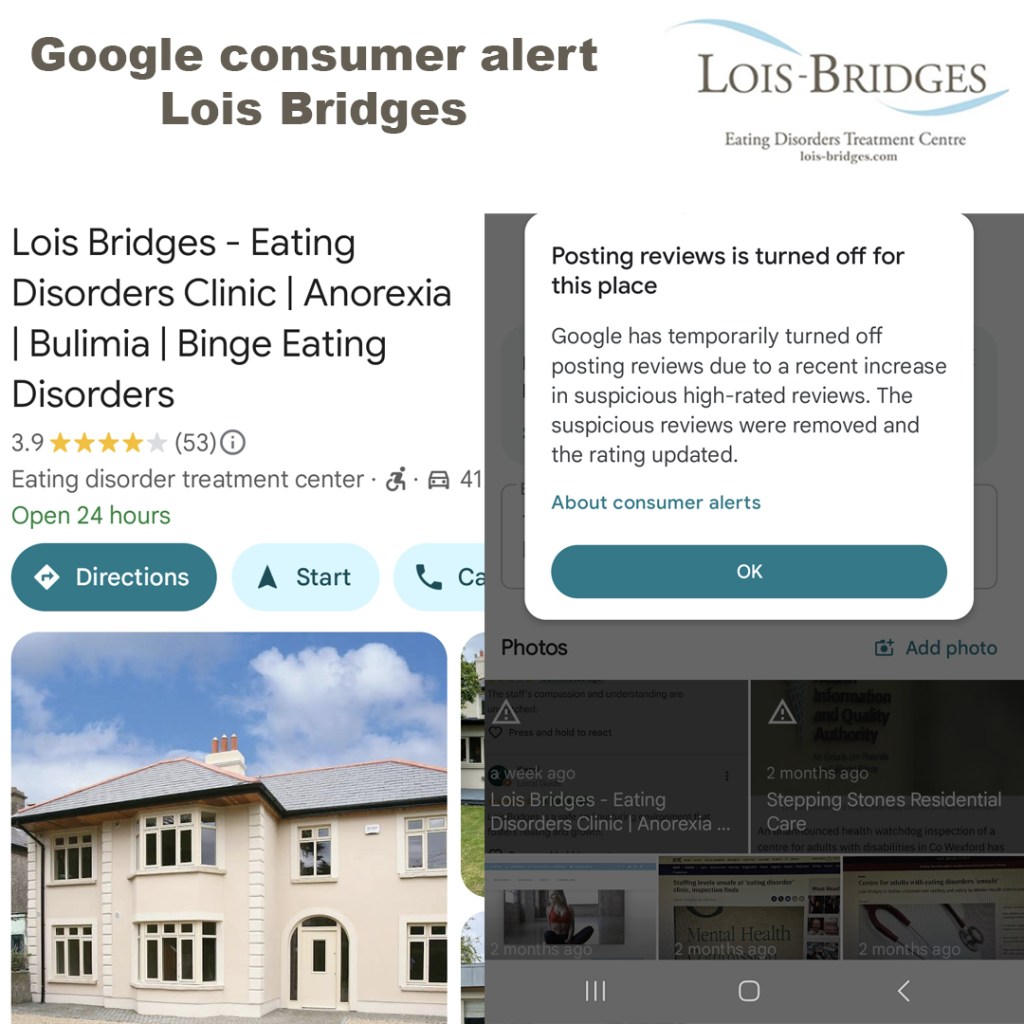


Lois Bridges eating disorder clinic Ireland
inspection report, appropriately trained member of staff not on duty
Reduction in standards from the inspection 2011 and 2012, some reducing to minimal compliance and not compliant and breaches of regulations
Lois Bridges on-call rota did not provide for an appropriately qualified person in charge at all times. The recruitment policy did not require clinical staff to be psychiatrically trained or have experience in the area of eating disorders. There was an individual care plan (ICP) in place for each resident. The ICPs were recorded in broad, generic terms. Policies on personal property and possessions not followed. Policy on confiscating mobile phones from residents. Lois Bridges did not try to recruit or employ staff experienced in treating eating disorders. Nowhere was Lois Bridges able to provide psychological assessments. individual clinical files contained scant accounts of individual psychotherapy sessions
Lois Bridges eating disorder clinic Ireland
Article 8: Residents’ Personal Property and Possessions
There was an up-to-date policy on residents’ personal property and possessions. Each resident had a property checklist on file. The policy stated that the property checklist completed at the time of admission should be signed by the resident and staff. This was not in operation in the individual files inspected. Residents were provided with guidance on what items to bring with them on admission. Each resident had a personal wardrobe and lockable storage. Residents were encouraged not to bring valuables when being admitted, however, safe storage was available if required.
Lois Bridges eating disorder clinic Ireland
Article 12 (1-4): Communication
There was a policy on communication. The policy stated that the use of mobile phones was prohibited and that if a “client is found in possession of their phone, the phone will be confiscated and held in the office safe”. Staff reported that residents did not retain their mobile phones whilst in Lois Bridges but were provided with the use of a house phone. Management subsequently stated that residents could retain their mobile phone but were required to leave their phones in their bedroom during therapy sessions. Residents could send and receive mail.
Lois Bridges eating disorder clinic Ireland
Article 15: Individual Care Plan
Each resident had an individual care plan (ICP).The ICPs were framed and recorded in broad and generic terms and would benefit from a clearer specification of individual needs, particularly psychological case formulation. Each resident was engaged in therapy or counselling with at least two staff and the scheduled appointments were faithfully recorded in the ICP. The purpose, aim and nature and outcome of interventions were not well recorded in the ICPs. ICPs predominantly featured needs such as “orientation, physically fit, safety and security, diet, therapeutic relationship” and this may have reflected the training orientation of the majority of nursing staff. Residents were fully involved in their own care planning process.
Lois Bridges eating disorder clinic Article 26: Staffing
The registered proprietor did not have an appropriately qualified staff member on duty and in charge of Lois Bridges at all times and a record thereof maintained in the approved centre.The on-call duty rota, for the week of the inspection visit, had the clinical director and a nurse alternatively rostered throughout the week. This on-call list provided to inspectors, did not include the surname of the nurse, nor was this nurse included in the staff list provided. The staff list provided to inspectors included eight nursing staff and the nurse in charge advised that just two nurses were registered psychiatric nurses (RPNs). The person in charge at night was generally a registered general nurse. Subsequent to the inspection, management stated that the consultant psychiatrist was on call at all times pending the appointment of a senior registrar. A newly appointed, part-time consultant psychiatrist had commenced in the role of clinical director, two weeks prior to the inspection visit. The post of director of clinical services was vacant but staff advised that an appointment had been made and a registered general nurse was due to commence in the near future. The person in charge at the time of inspection was a registered general nurse. Management subsequently advised that the new director of nursing and allied health services was an RPN.
Lois Bridges specialised in the treatment of adults with eating disorders. Residents had typically been in receipt of treatment previously. Inspection of individual clinical files and the expressed view of staff indicated that residents’ needs were often multifaceted and complex. Lois Bridges recruitment policy did not require staff to have specialist training or skills in the treatment of eating disorders. The majority of staff did not have specialist training or experience in the treatment of eating disorders. Lois Bridges did not provide psychological assessment and this gap was reflected in the case formulation in the individual clinical files. Lois Bridges did not ensure that the numbers of staff and skill mix of staff were appropriate to the assessed needs of residents. The staff list provided to inspectors listed ten psychotherapists or counsellors, two alternative therapists and a dietician. On inquiry by inspectors about the process of multidisciplinary team review and the sharing of clinical information, staff described a loose process which included relayed messages and were unable to state categorically where some clinical records were entered or held. Inspection of the individual clinical files contained scant accounts of individual psychotherapy sessions. Inspectors sought clarification about where the accounts of individual therapy sessions were recorded and management subsequently stated that all clinical records were held in the individual clinical file. Lois Bridges training record indicated that manual handling, basic life support and crisis prevention intervention training were up to date. Mental Health Act training was also provided.
Article 27: Maintenance of Records
There was a policy on the creation of, access to, maintenance and destruction of records. Records on food safety, health and safety and fire inspections were available for inspection. Fire inspection records included the fire certificate and a fire engineer’s quarterly reports on the maintenance of fire safety equipment. Staff reported that they had not completed a fire drill or evacuation exercise. The individual clinical files, although neat and organised into separate sections with dividers, did not contain an adequate and complete record of care. Information was not organised in a chronological order, for example, the admission record preceded the referral record. In one clinical file inspected there was no referral for admission, the clinical records on this individual clinical file predated the admission date by six months and there was no identified general practitioner or medical doctor for discharge purposes. The individual clinical records did not contain an adequate and meaningful record to support optimal care and treatment. Inspectors were provided with a list of ten psychotherapists and counsellors who provided therapy to residents. Inspection of the individual clinical files did not evidence adequate recording of therapy sessions. In two individual clinical files records of therapy sessions were entered and a brief reference was made to key issues arising in therapy. Allowing for appropriate information sharing, there was no elucidation of the key issues and it was not clear how the multidisciplinary team were apprised of the identified issues and how issues were factored into care planning. Inspectors sought clarification from staff as to how such information was shared across the treating team, whether the staff on duty at the time of inspection had knowledge of the issues mentioned, where the psychotherapists entered clinical records and how the psychotherapists contributed to the multidisciplinary ICP. Staff in charge on the day of inspection had neither the knowledge of the issues referred to in the individual clinical files nor where psychotherapists recorded clinical notes. There appeared to be no clear system in place other than a record for payment purposes. The written list of staff provided to inspectors did not contain all pertinent information, such as surname for example. It was a tedious exercise to sift through individual staff folders, including staff no longer listed as staff, in an effort to evaluate the training record. Inspectors suggested to the nurse in charge on the day of inspection that a single data sheet be used to provide an accessible record of staff training. The staff record in Lois Bridges did not contain details of next-of-kin in the event of an emergency.
Article 32: Risk Management Procedures
The risk management policies met the requirements of the Regulations. Each individual clinical file contained a risk assessment. The risk assessment form identified key risks, including, “risk of self harm, hopelessness, depression, suicide plan/intent, family concerned”. There was a guidance reference for staff on the criteria to rate the individual’s risk as low, medium or high. It was not evidently clear in the individual clinical files inspected, how the risk level rating was evaluated based on the risk items that had been identified. Inspectors recommended that a clear statement be recorded to elucidate the clinical reasoning. The inspectors asked whether staff had been trained in risk assessment and management. Management subsequently advised that training was being considered. Therefore, the inspectors did not consider the risk management policy to be fully operational.
Part 2 Enabling Good Practice through Effective Governance
Lois Bridges had policies and procedures on admission, transfer and discharge. A new clinical director had been appointed and a new director of clinical services was due to commence in the near future. The approved centre was not fully compliant with Article 26 on Staffing because an appropriately qualified member of staff was not on duty and in charge at all times. Lois Bridges was not fully compliant with Article 32 on Risk Management.
HOW MENTAL HEALTH SERVICES SHOULD WORK WITH PEOPLE WITH AN INTELLECTUAL
DISABILITY AND MENTAL ILLNESS
Staff reported that Lois Bridges did not admit individuals with an intellectual disability and mental illness. Lois Bridges policy stated that persons with an intellectual disability and a mental illness might, where appropriate, be admitted to Lois Bridges. Staff were not trained in the management of individuals with an intellectual disability and a mental illness.
Staffing levels unsafe at ‘eating disorder’ clinic, inspection finds
OVERALL CONCLUSIONS
A reliance on nursing staff and ten therapists and counsellors all of whom were contracted in to provide services, and the attendant requirement for coordination, may have accounted for the lack of clarity about personnel and interventions encountered by inspectors on the day.. It was difficult to ascertain the precise identified need, intervention and outcome in relation to psychotherapy and counselling in the individual clinical files. The clinical files did not contain an adequate record in relation to psychotherapy. The individual clinical records might be improved with enhanced psychological case formulation, explicitly stated need for psychotherapy and the focus of interventions and outcomes. At a governance level, there was some variance between stated policy and practice at the time of inspection. This should be addressed.
Lois Bridges eating disorder clinic Ireland RECOMMENDATIONS 2013
- Individual clinical files must be in one composite file and contain an adequate record of therapeutic
- The Registered Proprietor must ensure that there is an appropriately trained member of staff on duty and in charge of Lois Bridges at all times and that the number and skill mix of staff is appropriate to the assessed needs of residents.
- The policy on detention should be changed to reflect the Mental Health Act 2001.
- Admissions should meet the standard of the Code of Practice on Admission, Transfer and
- Policies should be reviewed to ensure coherence with practice on the ground.
Click here for link to full report






Leave a Reply